Dead Eyes: Reimagining the Forest Horror Genre with a First-Person Perspective
Few settings evoke fear as viscerally as the deep, unknowable woods. From the silent stalker of masked killers to the folklore-rooted terror of supernatural entities, forests have permeated horror cinema since its inception. But with Dead Eyes, director Richard E. Williams offers a distinct twist: immersive first-person camerawork that pulls audiences directly into the heart of paranoia and dread.
A Story Rooted in Loss and Monstrous Science
The movie introduces us to Sean, a man haunted by childhood trauma and the loss of his sister, Lilly, who drowned in an isolated lake near where their scientist father, Paul, raised them. Years later, following Paul’s mysterious disappearance, Sean returns to the woods with his fiancée Grace, his hedonistic best friend Eric, and Eric’s reluctant girlfriend Kate. What begins as a search for answers quickly escalates into a nightmare of cloned abominations and splintered realities.
After the group finds Paul’s abandoned shack, they stumble onto a chilling secret: Paul has been desperately attempting to resurrect Lilly through cloning experiments, inadvertently unleashing ravenous duplicates—each desperate to be the ‘real’ daughter. Here, the film draws subtle inspiration from the existential horror of Frankenstein while channeling the chaotic, ambiguous storytelling style seen in genre staples like The Blair Witch Project.
The Power — and Limits — of the First-Person Format
From its earliest moments, Dead Eyes leverages the first-person viewpoint to maximum effect. Audiences aren’t mere observers; they embody Sean, sharing in his nightmares and hallucinations. The camera lingers on the haunting silence of the trees, the sudden glimpses of shadowy figures, and the claustrophobia of being constantly watched. This technique not only heightens the impact of jump scares but also delivers a rare sense of continuity; many sequences transition so seamlessly that the film often appears to unfold in a single, unbroken shot.
This innovative approach, reminiscent of the relentless action of Hardcore Henry and the psychological unease of Maniac, rarely resorts to basic scene cuts. Instead, transitions occur through natural movements: Sean’s gaze drifting, sudden blackouts from violence, or moments where his hands obscure his vision. The result is a constant state of immersion, though it comes with technical limitations. Characters sometimes speak to a point above the camera instead of into Sean’s ‘eyes,’ and dynamic moments can be undermined by a camera that occasionally stays more static than the intensity of the scene demands.
Performances and Atmosphere: Chilling Standouts
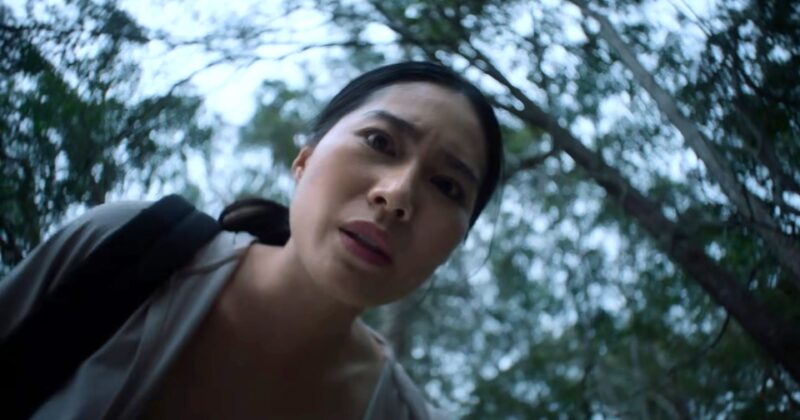
What anchors the film amidst its stylistic experiments are the performances. Ana Thu Nguyen delivers a layered, emotionally resonant performance as Grace—a character visibly fraying at the edges as reality unravels. Rijen Laine’s vocal work brings an eerie, otherworldly presence to the clones, further amplifying the film’s unsettling mood. Creature design here deserves special mention: the Lilly clones aren’t just horror props—they embody the terror of failed humanity, their hunger and confusion adding a unique dimension to the film’s central family tragedy.
A Narrative Wrapped in Mystery and Existential Dread
While the visual execution is often dazzling, the narrative grows increasingly opaque. Williams flirts with grand ideas about identity, personhood, and the cost of obsession—echoes of Mary Shelley’s most famous creation—but never quite crystallizes these themes. The final act offers more questions than answers, and the ambiguous fates of several characters leave viewers with unresolved tension. Unlike some horror films that use ambiguity to deepen their impact, Dead Eyes risks frustrating genre fans seeking closure. Yet, this refusal to fully explain itself may spark post-viewing conversations, just as the woods echo with unresolved fears long after the credits roll.
Pros and Cons: Weighing Innovation Against Accessibility
- Expertly executed first-person perspective delivers visceral, intimate scares rarely seen in the genre.
- Creature design stands out for its originality and unsettling impact.
- Acting by Ana Thu Nguyen and Rijen Laine elevates the emotional stakes.
- The narrative can feel elusive, at times too ambiguous for its own good.
- First-person format occasionally reveals its limitations, especially during action-heavy moments.
Dead Eyes is a film that should be experienced on its own terms: an immersive horror ride that fuses technical daring with classic genre atmosphere. If you crave your scares up-close and uncomfortably personal, Williams’ debut is not to be missed. It’s a welcome addition to the growing exploration of perspective in modern horror cinema.