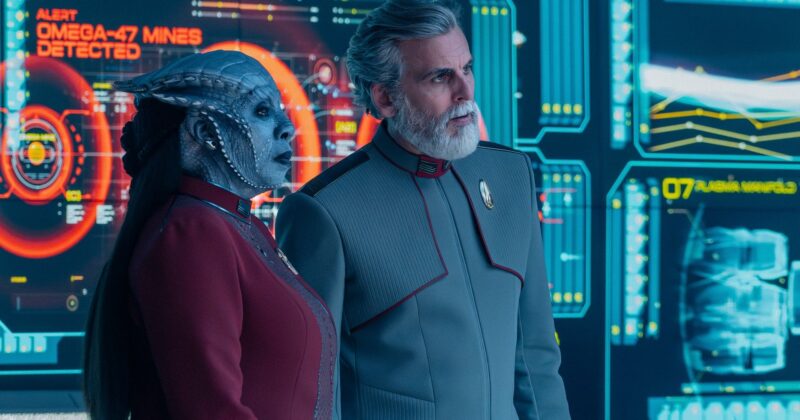
Klingon-Federation Tensions in Star Trek: Starfleet Academy
Star Trek has always thrived on the ever-evolving relationship between the Federation and the Klingon Empire. From the days when a single Klingon sighting had Enterprise security on edge to the diplomatic breakthroughs under Captain Picard, this dynamic continues to shape galactic politics and personal destinies. Now, Star Trek: Starfleet Academy takes that simmering tension and brings it to a fresh narrative boiling point.
The Fallout of «The Burn» and Klingon Survival
One of the most significant in-universe catastrophes—the Burn—left the Klingon homeworld, Qo’noS, in ruins. The House system crumbled, and only a handful of great houses survived, forcing Klingons into a nomadic existence. Federation support, previously taken for granted, is now viewed with suspicion. Conspiracy theories and deep-seated mistrust abound, resulting in only one known Klingon cadet, Jay-Den Kraag, attending the Academy as societies drift further apart.
The Klingons’ reluctance to accept Federation help in the search for a new homeworld exposes not just their legendary pride but a growing anti-Federation sentiment. Even the discovery of their «new Qo’noS» was orchestrated through a staged skirmish with Starfleet, where authenticity mattered less than narrative control. These nuances underscore just how far cooperation has regressed since the era of Worf donning a Starfleet uniform.
Non-Federation Coalitions and the Klingon Alignment
The latest twist in Starfleet Academy’s season finale is the ambitious scheme by Nus Braka, aiming to humiliate the Federation on a galactic scale and build a powerful alliance of worlds outside Federation influence. A crucial detail surfaces during a live broadcast: the «new Qo’noS» appears interested in joining Braka’s coalition. This is especially provocative given the Klingons’ earlier refusal of Federation aid, implying that their distrust is not just protocol—it’s political strategy.
Braka’s coalition is not merely a neutral third party; it stands in open opposition to the Federation. From mining Federation space to tactics that could threaten billions, Klingon actors find themselves tempted by these overt expressions of power against a traditional rival. Though the Klingon military remains a shadow of its former strength, and an outright war is unlikely in the immediate future, the seeds for proxy wars and new alliances have truly been sown.
Perspectives from Star Trek Lore and Pop Culture
Klingons have always been more than adversaries—they’re cultural icons, warriors governed by honor codes and centuries-old grudges. Their on-screen evolution, from the menacing figures of the original series to valued allies in later eras, reflects Star Trek’s deeper commentary on rivalry, trust, and the possibility (however faint) of reconciliation between historic enemies. The current era of Starfleet Academy returns to uncertainty, with allegiances shifting quickly as new power blocks, like Braka’s coalition, vie for influence in the Alpha Quadrant.
For Star Trek enthusiasts, these developments open up exciting narrative possibilities: Will a diminished but cunning Klingon faction spark another galactic confrontation? Can Starfleet’s ideals survive against coalitions bent on its downfall? The new storyline expertly channels classic Trek themes—power, honor, suspicion—and revitalizes them for a new generation, all against the backdrop of showrunner Alex Kurtzman’s ongoing stewardship.
As Klingons and the Federation once again circle each other with suspicion and strategic calculation, Star Trek: Starfleet Academy continues to push the franchise into unpredictable, richly layered territory. How these tensions play out will likely become a cornerstone for future storylines, reshaping fan expectations along the way.