Guillermo del Toro’s Cabinet of Curiosities: The Lovecraftian Masterclass on Netflix
The horror anthology Guillermo del Toro’s Cabinet of Curiosities on Netflix has sparked a renewed discussion among genre enthusiasts and creators: Can the bizarre, maddening, and cosmic terrors imagined by HP Lovecraft truly be translated to the screen? With critical acclaim and a sterling 93% on Rotten Tomatoes, this series proves, perhaps for the first time definitively, that it is not only possible but deeply effective.
The Lovecraft Dilemma: Influence and Inadaptability
HP Lovecraft shaped the DNA of modern horror, influencing luminaries from Stephen King to Guillermo del Toro himself. His stories drip with existential dread and the fragile boundary between the known and the unspeakable. But long-standing controversies around Lovecraft’s personal views, as well as the sheer difficulty inherent in embodying his cosmic horror—where the mere sight of a monster can shatter sanity—have made adaptations either cautious or overambitious to the point of incoherence.
How Del Toro Navigates the Lovecraftian Labyrinth
Cabinet of Curiosities confronts these challenges head-on by embracing the anthology format. Rather than sprawling epics, it focuses on tightly woven, self-contained tales. Here, the madness or demise of a character can be the narrative’s punctuation, not its ruin. This rhythm is central to bringing Lovecraft to modern viewers.
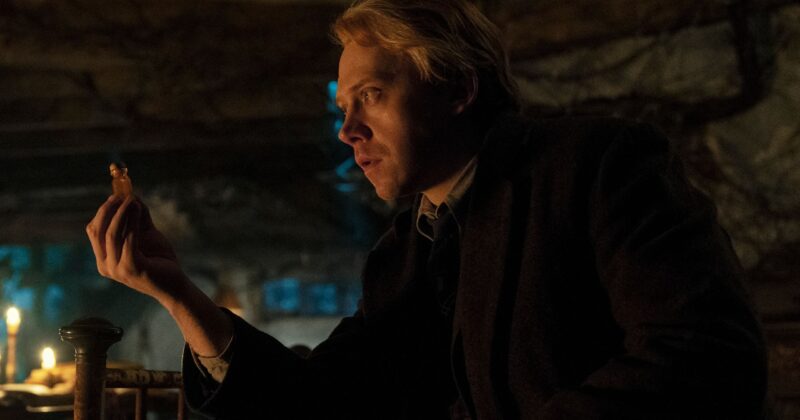
Two episodes, ‘Dreams in the Witch House’ and ‘Pickman’s Model’, offer direct Lovecraft adaptations—and deliver them with faithful darkness. They don’t overexplain their monsters. Instead, much is shown in shadows and suggestion, keeping the audience on edge, much like Lovecraft’s own literary approach. This delicate balance between depiction and implication lets the cosmic unease seep through every frame.
Lovecraftian Threads Through Every Episode
Even episodes not directly lifted from Lovecraft’s bibliography pulse with his influence. Del Toro’s opening chapter, ‘Lot 36’, teases a supernatural realm with rules unspoken and doors best left unopened. Meanwhile, in Panos Cosmatos’s visually feverish ‘The Viewing’, the act of beholding becomes a cosmic event, corrupting reality with darkly humorous flair that Lovecraft himself might have admired.
Anthology Format: The Secret Weapon
It’s the anthology structure that ultimately enables repeated success. The brief, contained storytelling prevents cosmic horror from feeling overwrought or diluted. Each director has a bite-sized canvas to explore themes of madness, forbidden knowledge, and existential dread without betraying the overwhelming scale that Lovecraft’s mythos demands.
This also offers a practical roadmap for future adaptations. Rather than laboring to render titanic entities like Cthulhu or Nyarlathotep in exhaustive CGI, the series thrives on implication and psychological decay. Hints of a nightmare world are often more potent than its full reveal. For example, ‘Lot 36’ masterfully evokes the terror of discovering something unspeakable lurking just out of sight, without succumbing to the temptation of spectacle for its own sake.
Current Significance and Technical Execution
Cabinet of Curiosities also excels through its technical craftsmanship. Cinematography leans heavily into practical effects, tactile environments, and oppressive soundscapes. Directors like Jennifer Kent and David S. Goyer join Del Toro in ensuring every frame is saturated with tension. The anthology’s structure is not only a narrative choice, but a technical one—enabling a different visual language or directorial vision with each episode, echoing the intricate patchwork of cosmic horror in literature.
Audiences who crave more than jumpscares will find episodes densely layered. Fear is rooted not in what is seen, but in what is implied—the horror of infinite unknowns. This is pure Lovecraft: forcing the viewer to imagine the darkness beyond the screen. Del Toro’s approach serves as a masterclass in adaptation, potentially shaping how cosmic horror is brought to streaming platforms going forward.
Ultimately, Guillermo del Toro’s Cabinet of Curiosities stands not only as a triumph of adaptation, but as a blueprint for future creators aiming to conjure Lovecraftian fear for a new era.