Invincible Season 4: Why Mark Grayson Embraces His Classic Costume Again
Ever since its debut, Invincible has set itself apart with raw storytelling, complex characters, and a willingness to move well beyond the tropes of standard superhero animation. As the latest season unfolds, one of the most symbolic visual decisions centers on Mark Grayson reverting to his original costume—a choice packed with emotional weight, technical storytelling, and broader significance for the character’s arc.
The Evolution of Invincible’s Costumes: More Than Just Aesthetic
Mark’s journey is visually marked by his costumes, reflecting growth, doubts, and shifting identities. After years grappling with his father Omni-Man’s legacy, fighting world-ending threats, and suffering losses that test his morality, Mark’s blue-and-black suit stood for a more hardened, mature approach to heroism. Viewers recognized this as a turning point: the visual palette grew darker as his story did too, mirroring the maturity and the heavy burdens he carries.
But with great power—and trauma—comes introspection. Mark’s grim evolution reached a breaking point through one particularly haunting event: the death of Rus Livingston. Rus wasn’t an enemy, but a civilian inadvertently caught in the crossfire, forcing Mark to reconsider everything his recent path represented. The suit that was supposed to symbolize progress now felt tainted, bound to a period of inner turmoil and moral conflict.
Killing Rus Livingston: Regret and Revelations
Rus’s death is a narrative jolt not only for the character but for longtime Invincible fans who have seen Mark struggle with the true cost of power. Mark’s struggle wasn’t an isolated incident—he also lost control fighting Dinosaurus and barely stopped himself from crossing yet another line with Titan. These moments signal a hero still learning where the line is, a constant challenge in the Invincible universe where the distinction between vigilante justice and villainy is razor-thin.
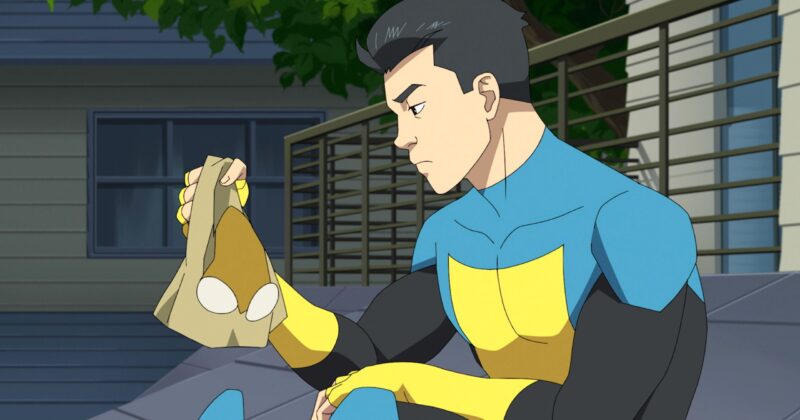
This substantial regret led Mark to conclude he was unworthy of the new suit’s message. In a heartfelt moment with Art Rosebaum—tailor, confidant, and the quiet wisdom behind so many superhero façades—Mark hands over the blue-and-black suit, unable to separate the trauma from the uniform. Art’s role here is vital: he offers perspective without judgment, reassuring Mark that feeling remorse sets him apart from his father, Omni-Man. For those who relish character-driven drama, this is a masterclass in subtle animation and writing. The return of the yellow-and-blue classic suit is more than nostalgia—it’s a lifeline, a reminder of the reasons Mark first chose to fight.
Art Rosebaum: Mentor, Tailor, and the Heart of Invincible
Art’s advice cuts through the chaos. Instead of pushing Mark forward, he encourages him to reconnect with his origins. ‘You’re still the kid who came in here wanting to make the world a better place,’ Art tells him. This isn’t just a callback to the show’s first season—it’s an invitation to reclaim hope amid darkness. Costume changes in superhero lore are often about branding, but here it’s about identity, redemption, and that ongoing conflict between human fallibility and superhuman responsibility.
Mark’s Descent Into Hell—and Clarity Through Darkness
Just as Mark prepares to don the old suit, a storyline unique to the animated series takes him—literally—into Hell. Guided by Damien Darkblood, a fan-favorite detective with supernatural ties, Mark faces physical and psychological demons. In Hell, surrounded by monsters, Mark defeats Volcanikka, proving to both himself and viewers that heroism persists even when things seem lost. This hellish detour, a divergence from the comic arc, deepens the stakes and delivers fresh character insights, showing that even under unimaginable pressures, Mark can reclaim some measure of optimism.
Emerging from the underworld, his decision to wear the original costume isn’t just a sartorial change. Mark is smiling, flying again—a fleeting moment of peace before more inevitable battles. This is where Invincible truly excels, using superhero tropes to examine trauma, growth, and the cyclical journey of finding (and losing) oneself.
The Significance for Invincible’s Future
With enemies like Thragg looming and the Viltrumite War drawing near, Mark’s internal realignment marks a vital preparation for what lies ahead. The original suit stands as a symbol of humility, lessons learned, and the promise that no hero—no matter how bruised—must be defined by their darkest moments. Invincible continues to push the boundaries of what animated superhero storytelling can be, and this costume shift is a visual testament to that ongoing transformation.
Fans invested in Mark Grayson’s journey know that every detail matters, and here, the return to the classic look is a beacon amidst chaos—showcasing that even in a universe filled with cosmic threats, the small, personal victories still mean everything.