Rediscovering The Mummy Through a Modern Horror Lens
Few cinematic creatures inspire as much fascination as the mummy, an icon that has evolved through decades of horror and adventure. In the newest reimagining, director Lee Cronin takes the franchise to chilling new depths, pushing narrative and visual boundaries to shake up what audiences expect from ancient terrors. This time, it’s not just dusty tombs and curses—it’s intimate horror, brought unnervingly close to home.
The Sinister Resurrection: A Family’s Nightmare
Cronin’s vision follows the harrowing tale of a family whose daughter, Katie, mysteriously vanished for eight agonizing years. When she’s finally found, not wandering lost but entombed within an ancient sarcophagus, the real nightmare begins. Katie is alive—but deeply altered, her presence tainted by whatever horror she endured sealed away. With raw family drama as its backbone, this version diverges from standard mummy fare and lands squarely within elevated horror territory.
First Look: 4DX and ScreenX Posters Redefine Fear
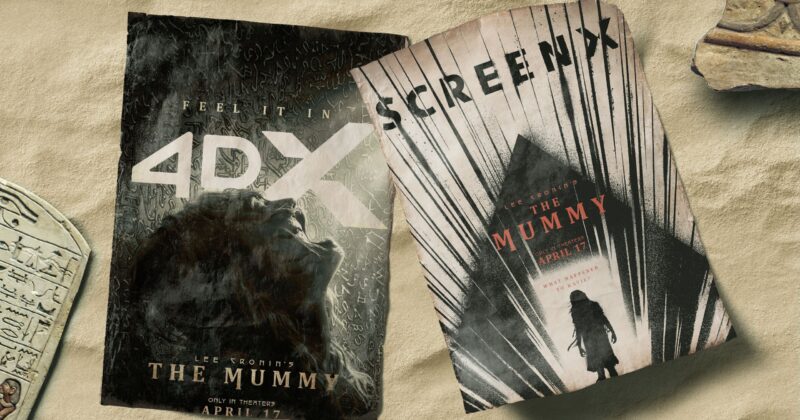
Promotional art plays a crucial role in setting a film’s tone, and The Mummy does not disappoint. The 4DX format poster puts Katie in an intense, screaming profile, surrounded by an ominous script—not classic hieroglyphics, but something more arcane and foreboding, hinting at mysteries far removed from simple tomb robbing. In contrast, the ScreenX poster frames Katie in silhouette, dwarfed by a pyramid and illuminated by a dazzling yet sinister doorway, visually slicing through the canvas with the same precision the film aims to drop into your nerves.
4DX & ScreenX: Horror Without Escape
Modern horror often finds ways to keep its audience at a distance—but with the premium formats chosen for The Mummy‘s release, that protective barrier all but vanishes. ScreenX, with its 270-degree panorama spanning three screens, does away with standard widescreen limitations. The terror unfolds not just ahead but along your peripheral vision, amplifying the feeling of being surrounded by the unknown. Catching a breath, or glancing away to avoid a jump scare, becomes nearly impossible within this cinematic environment.
Meanwhile, 4DX theaters challenge what it means to «feel» a movie. Here, the seats tremble with the sarcophagus’s opening, mists and scents fill the air, and gusts of wind echo supernatural forces breaking through the screen. Imagine being enveloped in the musty chill of an ancient tomb or startled by a physical jolt as the undead break free—it’s visceral immersion, extending the horror from simple visual engagement to a full-body experience. For fans of experimental cinema, 4DX pushes horror toward total sensory assault, making each viewing unique and unpredictable.
Industry Context: Why Premium Formats Matter
Cinema technology rarely stands still. As streaming gains ground, theaters fight to make each visit an event, not just a routine. Films like The Mummy present an ideal test case for the latest immersive tech—demonstrating how physical effects and panoramic visuals can revitalize classic monsters, bringing fresh relevance to stories once deemed old-fashioned. With studios choosing filmmakers like Lee Cronin, known for his expertise in atmospheric tension (see his previous work in supernatural horror), the experience is not just about spectacle but crafted suspense that utilizes technology for genuine storytelling impact.
Key cast includes Jack Reynor, Laia Costa, May Calamawy, and Billie Roy, working under genre visionaries Jason Blum and James Wan as producers. Their involvement further signals a project committed to excellence both in scare factor and cinematic craftmanship.
Tickets for premium formats are already highly sought after, reflecting a growing appetite for immersive moviegoing that bridges old horror mythologies with the innovations of modern cinema. Those eager to explore new boundaries in fear can follow studio newsletter updates for exclusive format reveals, tech deep-dives, and developments in genre-driven storytelling.