Delving into Primer: The Indie Time Travel Film That Demands Your Full Attention

Why Time Travel Stories Often Leave Us Scratching Our Heads
Time travel as a storytelling device in cinema and television is a captivating but notoriously complex genre to master. It teeters on the fine edge between captivating mind-benders and frustrating labyrinths of paradoxes, loops, and narrative twists. While many time travel tales opt for straightforward loops or rely on emotional arcs to keep audiences engaged without overwhelming them, others dive headfirst into convoluted timelines that can make even the keenest viewers feel lost.
For fans of science fiction who thrive on intellectual stimulation, the genre can become an elaborate puzzle. Some films cleverly provide all the clues needed to piece together their intricate plots but require sharp observation and repeated viewings. This balancing act between creating accessible yet challenging narratives is what separates merely good sci-fi from films that become cult classics.
Primer: Indie Ingenuity Meets Scientific Realism
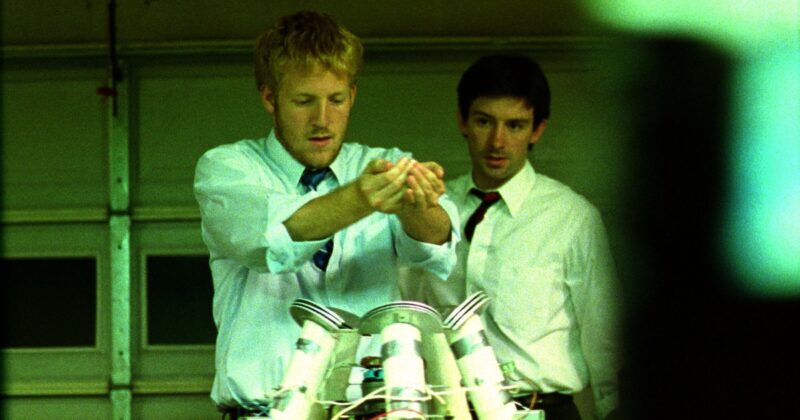
Emerging from the indie scene, Primer, written and directed by Shane Carruth, offers a unique take on time travel that stands apart from blockbuster fare. At its core, the film follows two engineers, Aaron and Abe, who accidentally invent a device capable of manipulating time during a side project in a garage. The film refuses to dilute its scientific jargon or mechanics, instead presenting time travel as a discovery laden with complexity and uncertainty.
Unlike more conventional time travel movies that simplify their premises to target broader audiences, Primer trusts its viewers to engage with the material intellectually. This approach results in a demanding but rewarding experience, as the film’s tight runtime—just over 77 minutes—doesn’t allow much leeway to pause or simplify. Viewers are compelled to pay close attention to minute details and subtle narrative shifts that are crucial to understanding the progression of events.
The Science Versus the Story: A Technical Dance
One of the remarkable aspects of Primer is its portrayal of the protagonists’ scientific process. Discussions between Aaron and Abe delve into the logic behind their experiments, showcasing a realistic scientist’s approach without over-explaining or resorting to convenient plot devices. This decision transforms the audience into co-investigators, translating abstract science fiction into tangible exploration.
However, this immersive approach comes with trade-offs. As the characters grapple with the ramifications of their invention, the plot becomes increasingly complex, mirroring their confusion and escalating stakes. The narrative’s refusal to spoon-feed explanations means the film’s final act can feel impenetrable, embodying the very paradoxes it explores.
Redefining Time Travel Through Perspective
Primer excels by positioning viewers alongside its protagonists, not as omniscient narrators but as participants discovering the machine—and its consequences—for the first time. This fresh perspective offers a grounded and visceral take on time travel, avoiding the typical spectacle-driven tropes of sci-fi cinema.
The film’s commitment to authenticity extends to its visual style as well. Carruth’s background in mathematics and engineering informs the film’s minimalist cinematography and restrained special effects, creating an austere atmosphere that amplifies the tension and realism of the unfolding narrative.
Why Primer Remains a Must-Watch for Sci-Fi Enthusiasts
Though its reputation for complexity may deter casual viewers, Primer rewards those willing to embrace its challenges. Beyond its perplexing plot, it showcases meticulous screenplay craftsmanship, deeply convincing performances, and a raw aesthetic that shuns Hollywood gloss in favor of authenticity. It’s a film that doesn’t just tell a story about time travel but immerses you in the very cognitive turmoil that accompanies such a groundbreaking and dangerous discovery.
For science fiction fans yearning for cerebral cinema that respects their intelligence, Primer offers a rare and invigorating viewing experience. It reminds us that good storytelling transcends simplicity and spectacle, demanding engagement, patience, and curiosity.