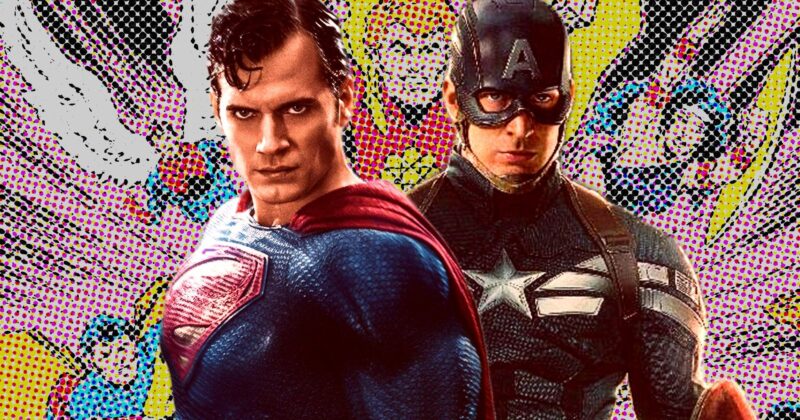
Marvel’s Squadron Supreme: The Accidental Powerhouse Born from a Scrapped DC Crossover

How a Cancelled Crossover Gave Birth to Marvel’s Parody Superteam
Comic book history is filled with legendary alliances and battles, but sometimes, the best stories come from creative risks that never officially happen. One of the most fascinating legacies to come out of the never-ending rivalry between Marvel and DC is the unintended creation of the Squadron Supreme—a team that started as a wink to Justice League fans and evolved into one of Marvel’s most entertainingly overpowered teams.
The Secret Origins: Marvel and DC’s Hidden Collaboration
Back when crossovers between the two comic book giants were rare and generally taboo, the creative teams behind the Avengers and the Justice League of America schemed to make comic book magic happen. Writers Denny O’Neil and Roy Thomas, friends working respectively on DC’s Justice League of America and Marvel’s Avengers, dreamed of orchestrating a showdown. But licensing and legal barriers made an official crossover almost impossible.
The workaround? Each team secretly planned to introduce a thinly veiled version of the other’s lineup in their own books. On Marvel’s side, Roy Thomas and artist Sal Buscema assembled the Squadron Sinister—a group that looked suspiciously familiar. Hyperion echoed Superman, Nighthawk mirrored Batman, Doctor Spectrum played off Green Lantern, and Whizzer was a direct nod to Flash. These not-so-subtle doppelgängers debuted in Avengers #69-70, providing Marvel readers with a sly, villainous homage to the Justice League.
Meanwhile, DC’s attempt to parody the Avengers in Justice League of America was shot down by editorial oversight. Ironically, this censorship only enhanced the Marvel parody’s notoriety, giving the Squadron Sinister free rein to make an impression in the Marvel universe.
From Sinister to Supreme: The Team Evolves
While the original Squadron Sinister served as a one-off pastiche, the idea stuck with Roy Thomas. Soon after, he reintroduced the concept, this time flipping the narrative: Avengers would encounter a heroic version known as the Squadron Supreme. This alternate-reality team took homage to a new level, boasting analogs for almost every major Justice League member—Lady Lark for Black Canary, Tom Thumb for Atom, and American Eagle for Hawkman, among others.
The Avengers’ meetings with the Squadron Supreme—particularly across what would later be known as Earth-712—delighted fans who recognized the playful intercompany rivalry. But the creative experimentation didn’t stop there. Squadron Supreme eventually spun off into some of the most deconstructionist and ambitious stories in superhero comics, including the critically celebrated miniseries by Mark Gruenwald and Bob Hall. Later, J. Michael Straczynski and Gary Frank’s run reimagined the squad for a new era as Supreme Power, eventually folding them into Marvel’s 616 multiverse.
DC’s Countermove: The Champions of Angor
Not to be left out, DC eventually followed up with their own tongue-in-cheek Avengers homage: The Champions of Angor. Introduced as antagonists for the Justice League, this lineup included Blue Jay (echoing Ant-Man), Jack B. Quick (a Quicksilver archetype), Silver Sorceress (modeled after Scarlet Witch), and Wandjina (channeling Thor). While a clever nod, the Champions never achieved the same legacy. Post-Crisis stories relegated them to the margins, punctuated by tragic fates, including nuclear devastation and the decimation of their world.
Some, like Blue Jay and Silver Sorceress, briefly found new purpose with the Justice League International. Yet their story became a poignant footnote in the wider tapestry of comic book pastiche and homage.
The Enduring Legacy of the Squadron Supreme
What began as a cross-company in-joke has blossomed into a celebrated element of Marvel continuity, with the Squadron Supreme continuously offering both tribute and innovative commentary on the superhero genre. Their legacy is felt not only in comics but also in animation and merchandise, standing as a testament to the irrepressible creativity—and friendly rivalry—at the heart of superhero storytelling. The ongoing evolution of these characters keeps them relevant in today’s era of multiverse crossovers, ensuring they remain a fan-favorite intersection of meta-fiction, parody, and genuine heroics.