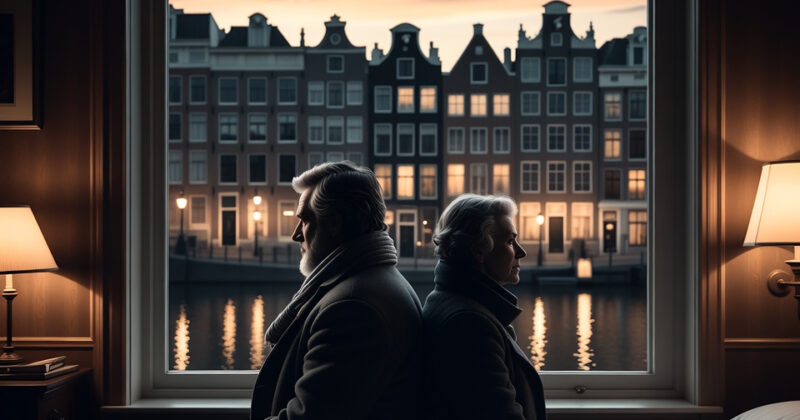
Midwinter Break: A Portrait of Love in Permafrost
Midwinter Break is not your average marital drama. Adapted by Nick Payne from Bernard MacLaverty’s celebrated novel and directed by the acclaimed theatre artist Polly Findlay, the film presents itself as a muted meditation on a lifetime of subtle pain. Rather than courting melodrama, it instead simmers in a near-icy quietude, focusing its lens on Stella (Lesley Manville) and Gerry (Ciarán Hinds), a retired Irish couple whose long-avoided wounds surface during an unexpected holiday in Amsterdam.
The Art of Repression
What stands out immediately about Findlay’s adaptation is its absolute resistance to traditional cinematic catharsis. There are no sudden revelations, no shattering arguments erupting over dinner tables, no tears shed in the rain. Stella and Gerry are products of their own silence, experts at avoiding conflict to a degree so practiced it has become their second skin. This approach, while intellectually interesting, brings with it an unnerving stasis: scenes are heavy with glances that reach nowhere, conversations that drift unresolved under the surface of banal routine.
Payne’s script attempts to dramatize the aching ordinariness of a couple whose communication has not only broken down, but fossilized. The actors’ performative subtlety, particularly from Manville and Hinds, carries vast unspoken histories with each look and sigh. Yet, despite these heavyweight performances, Findlay’s heavy reliance on implication over revelation renders much of the tension diffuse. The absence of emotional peaks becomes its own statement on the consequences of a life lived in internal exile. For many viewers, this means the drama feels as frozen as its title suggests.
Memory as a Labyrinth
Flashbacks trickle through the narrative, offering glimpses – not answers – into a formative trauma in Belfast that unsettled Stella and Gerry’s marriage. Findlay maintains a painterly restraint here, preferring suggestive images over explicit recounting: children at play, a woman in vibrant yellow, blood mingling with milk. The truth is ultimately less important than the way its ghost lingers, reshaping Stella and Gerry’s relationship in quietly devastating ways.
One of the film’s most compelling moves is its refusal to let the past overshadow the present. Instead, it examines the rift between these two characters – she, attending midnight mass alone; he, dozing in an armchair, distanced by habits as simple as late-night snacking. The gulf is never just religious or emotional, but a lived-in comfort with estrangement. Their holiday to Amsterdam, purchased almost impulsively by Stella, is less an act of romance than a last attempt to rediscover, or perhaps escape, their once-shared connection.
The Underpowered Fireworks of Conflict
While the set-up hints at the promise of explosive revelations, Findlay subverts expectation by exploring what happens when the years dull not only the pain, but the impetus to confront it. Stella seeks solace in faith; Gerry, in solitary defiance and secret whiskey. Both punish and forgive in equal measure, but rarely communicate openly about their needs or old wounds. The film never forces a reconciliation or a devastating break—it offers only the persistent ache of things unspoken and the comfort (or curse) of habitually repressed grievances.
There are moments when Findlay’s patients-for-quiet mirrors the actual experience of a marriage in crisis far better than standard cinematic shorthand. However, this authenticity comes with a trade-off: the film’s emotional minimalism mutes the drama so deeply that some viewers might find themselves left out in the cold. The unrelenting stillness will alienate those expecting visible transformation or dramatic closure.
Cinematic Craft and Performances
Visually, the film leans into its literary roots—still frames, deliberate blocking, an almost glacial editing rhythm. Amsterdam’s subdued winter palette perfectly encapsulates the state of Stella and Gerry’s bond. Lesley Manville and Ciarán Hinds bring depth and lived-in authenticity to their roles, subtly etching decades of love, disappointment, and longing into every exchange. Their performances are a masterclass in restraint, anchoring the film even when the script’s temperature drops perilously low.
MacLaverty’s material is deeply introspective and, at times, feels more at home on the page than on the screen. Film, after all, is an art of images and action, and Midwinter Break often asks the audience to simply watch a couple struggle to speak, again and again. This can be a tough sell, even to lovers of somber, character-driven cinema.
Who Is This For?
Fans of nuanced, slow-burning relationship dramas will appreciate the honesty of Findlay’s approach, particularly in an era where oversaturated spectacle often drowns out delicate storytelling. If you’ve admired the emotional intricacies of films like 45 Years or Amour, Midwinter Break provides a similarly austere—but perhaps even more ambiguous—experience.
For those seeking a bold, emotionally raw take on marriage, or those interested in the ever-relevant discussion of faith versus disbelief in the intimacy of a long-term relationship, there are rich undercurrents to parse here. Just be prepared for a drama that values authenticity above accessibility, and that leaves more space for reflection than for narrative satisfaction.