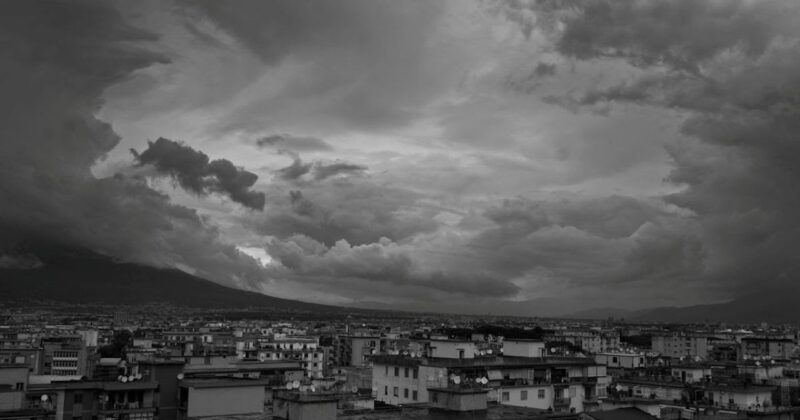
Pompei: Below the Clouds – An Immersive Experience in Naples’ Liminal Reality
Gianfranco Rosi delivers a deeply human exploration in his latest documentary, Pompei: Below the Clouds. Renowned for his lens on societies at the edge, Rosi once again turns his attention to the fragile, layered existence of Naples – a city where impermanence isn’t just a sensation, but a daily reality. Shadows of ancient destruction from Vesuvius and Pompeii loom over contemporary life, with modern apartments perched alongside remnants of untold catastrophes. This is a place where the past, present, and a precarious future co-exist in an uneasy but visually compelling harmony.
Life Beneath Imminent Threat: Contrasts and Continuity
Naples, framed through Rosi’s signature digital black and white chiaroscuro, is a city always on the verge, its inhabitants both vigilant and vibrant. The documentary details the juxtaposition of contemporary constructions alongside World War II rubble and ancient Roman echoes, emphasizing the unique specificity of urban life here. Each street tells a story: new facades mask ancient scars, daily routines unfold with an unspoken awareness that everything could change in an instant.
Portraits from the Edge: Humanity in Focus
Rosi’s work is a tapestry of diverse characters, each worthy of a film in their own right. An archaeologist methodically sorting through broken statues, a passionate bookstore owner who doubles as a community mentor, Middle Eastern refugees caught in bureaucratic limbo, and an international archaeological team unearthing Pompeii’s secrets all animate this portrait of life on the threshold. The resourcefulness and exhaustion of Naples’ emergency workers, responding to every tremor or suspected eruption, adds urgency and authentic drama to every frame.
Humor, too, finds a place. Rosi captures everyday absurdities that lighten the existential weight, like a stubborn resident debating the logic of her fire department’s efforts or the understated wit lacing casual conversation amid the chaos of uncertainty.
Cinema as Archive: The Layers of Memory
Pompei: Below the Clouds distinguishes itself by reflecting on cinema’s own archival role. Interludes in a deserted movie theater showcase classic films and documentaries about Pompeii and Mount Vesuvius, folding layers of narrative into the viewing experience. Rosi’s choices invite comparison between the mythic destruction depicted onscreen and the fates quietly endured offscreen. The editing, orchestrated by Fabrizio Federico, amplifies this effect—contrasting aerial cityscapes with the cacophony of emergency calls, grounding the myth in the tactile reality of Naples today.
Timeless Tensions and Modern Resonance
Perhaps the most striking achievement of Pompei: Below the Clouds is its ability to make the ephemeral tangible. As an archivist muses over catalogued relics—‘In this room, time is overlapped, mixed, abandoned. It’s a good metaphor for time, and the history of mankind… this accumulation of history preserved here.’—the film becomes less a linear narrative and more a living palimpsest. Rosi dissolves the barriers between epochs; in any shot, viewers slip between eras, experiencing past devastation, present endurance, and future anxiety all at once.
The documentary asks if we all—like the Neapolitans—are unconsciously living in liminal spaces, navigating ordinary days under the looming shadow of larger forces, from climate crisis to geopolitical strain. Yet, through evocative visuals and grounded vignettes, Rosi uncovers moments of beauty and absurdity, resistance and grace, drawn from the pulse of daily Naples.
Technical Excellence and Narrative Depth
Beyond its visual artistry, the film’s technical achievements are notable. Rosi’s use of digital monochrome gives each scene a sculptural clarity, while the editing crafts a rhythm that oscillates between tension and release. This experimental approach adds both poetry and challenge—the film’s length and density call for an audience ready to engage fully with its layered meanings.
Pompei: Below the Clouds stands as a profound work in contemporary documentary cinema. For those fascinated by urban history, the edge-of-disaster genre, or simply breathtaking visual storytelling, this film offers a rare, atmospheric window into a world where the past is never fully buried and the future always uncertain.