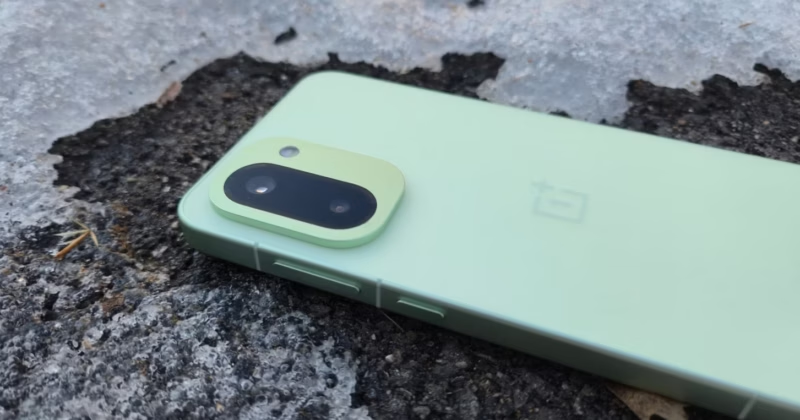
With premium materials and the largest battery ever included in a OnePlus smartphone, the OnePlus 15R arrives with a very clear selling point. Its enormous autonomy is made possible by a new generation of battery technology that pushes current limits, although its long-term durability is still something that only time will truly confirm.
OnePlus 15R: a premium feel without flagship pricing
The OnePlus 15R positions itself as a slightly more affordable alternative to the standard OnePlus 15. To achieve this lower price, the company makes several calculated compromises: a slightly less powerful processor, fewer cameras, slower charging speeds and the inclusion of a USB 2.0 port. Even so, the overall experience feels far removed from what most users associate with a mid-range device.
Despite these adjustments, the phone maintains a solid and refined construction combining metal and glass, delivering a premium sensation in hand. Its standout feature is undoubtedly the massive 7,400mAh battery, which even surpasses the capacity found in the regular OnePlus 15 and places it among the smartphones with the largest batteries currently available in the US market.
Price and availability
The OnePlus 15R starts at $700 for the 256GB version, representing a $200 saving compared to the base OnePlus 15. A 512GB configuration is also available for $800. Both models can be purchased in Charcoal Black or Mint Breeze finishes.
Design: familiar, solid, but not distinctive
Taking the OnePlus 15R out of the box creates an immediate sense of familiarity. Its design language closely resembles that of modern Pixel devices, with clean lines, flat surfaces and a sturdy overall construction. This similarity is not necessarily negative, as the device feels durable and cohesive, but it also means the phone lacks the visual identity that once defined OnePlus smartphones.
Unlike previous generations, there is no bold camera module, no distinctive rear texture and no prominent branding collaborations. The design is minimalist to the point where, without the logo, it could easily be mistaken for another Android phone.
The phone adopts a completely flat design across the display, back panel and sides, with only slightly rounded corners improving ergonomics. However, its size and weight make it feel noticeably bulky. Users accustomed to compact devices may find one-handed use uncomfortable, especially when adding a protective case.
Still, there are no clear structural weaknesses. Those who prefer large slab-style phones will likely appreciate the robust build quality and balanced finish.
Performance close to flagship territory
OnePlus originally built its reputation around delivering flagship-level performance at a lower cost, and the 15R partially revives that philosophy. While it is not marketed as a true flagship, its price undercuts devices like the iPhone 17, Pixel 10 and Galaxy S25 by roughly $100.
Powered by the Snapdragon 8 Gen 5 processor and paired with 12GB of RAM, performance remains consistently smooth. In everyday use, app launches, multitasking and gaming feel fluid, with no noticeable slowdowns or stuttering. Benchmark differences compared to higher-end chips exist on paper, but most users will never perceive them during real-world usage.
Storage also starts generously at 256GB and scales up to 512GB, matching or exceeding many competing devices released in the same period.
The display is one of the strongest aspects of the phone. Featuring an adaptive refresh rate reaching up to 165Hz in supported games and a resolution of 2800×1272, the panel achieves sharp visuals with approximately 450 pixels per inch. Brightness levels are more than sufficient for outdoor visibility, maintaining clarity even under direct sunlight.
One significant limitation, however, is the USB-C port. The continued use of USB 2.0 prevents video output entirely, meaning external displays, desktop modes or screen mirroring are not supported. For users interested in mobile gaming setups or future Android desktop integrations, this omission may be a decisive drawback.
The defining feature: an enormous battery
Battery life is where the OnePlus 15R clearly separates itself from competitors. Its 7,400mAh capacity rivals small power banks and exceeds the batteries found in many ultra-premium smartphones costing significantly more.
This achievement is possible thanks to silicon-carbon battery technology, which allows higher energy density compared to traditional lithium-ion batteries. While this technology has already appeared in several Chinese smartphones, major global brands have adopted it cautiously due to long-term reliability concerns.
Silicon-carbon batteries experience greater expansion under heat and stress, particularly during charging cycles. Manufacturers like Apple and Samsung tend to avoid rapid adoption of newer chemistries until extensive real-world testing confirms stability. For consumers, this introduces a trade-off: exceptional battery life today versus some uncertainty about long-term degradation.
In practical use, the results are impressive. The OnePlus 15R comfortably lasts two full days on moderate usage, and light users may extend that even further. Reverse wireless charging also allows the device to function as a portable battery for accessories or other phones.
Charging speeds: fast, but with conditions
Although OnePlus advertises charging speeds up to 80W, achieving these figures requires proprietary SuperVOOC chargers. Standard high-wattage USB-C chargers do not unlock maximum performance.
The included 55W charger delivers strong charging speeds on paper, but the massive battery capacity changes expectations. Because there is simply more energy to replenish, charging times end up feeling comparable to smaller-battery phones using slower wattage systems. Fully charging the device from empty still takes slightly over an hour.
Another consequence of such a large battery becomes noticeable when using external power banks. A 10,000mAh portable charger that might recharge a typical phone twice will realistically provide only a single full recharge for the 15R. Fortunately, the need for external batteries becomes far less frequent.
One notable omission is wireless charging. While understandable given the battery size and potential heat generation, its absence may disappoint users accustomed to built-in charging pads in cars or desks.
Cameras: where compromises become visible
The camera system represents the clearest downgrade compared to the standard OnePlus 15. Instead of three sensors, the 15R includes only two rear cameras.
The primary 50MP Sony IMX906 sensor delivers excellent results, producing detailed images with strong dynamic range and reliable low-light performance. For everyday photography, social media content and family moments, image quality remains highly satisfying.
The secondary ultra-wide camera, however, drops to just 8MP. This leads to a noticeable decline in quality when switching to wider framing, and the absence of a dedicated telephoto lens means zoom relies entirely on digital processing. Beyond modest zoom levels, image clarity deteriorates quickly.
Video recording reaches 4K at 120fps with optical stabilization, though 8K recording available on the flagship model is missing. For casual recording and personal memories, performance remains perfectly adequate, even if it falls short of professional expectations.
The 32MP front camera captures detailed selfies and supports 4K video recording at 30fps, though frame rate options remain limited regardless of resolution.
Software experience: increasingly divisive
Software may ultimately be the most polarizing aspect of the OnePlus 15R. OxygenOS has gradually evolved toward a design heavily influenced by Oppo’s ColorOS, blending visual elements reminiscent of both iOS and Google’s Pixel interface.
Rather than feeling uniquely OnePlus, the system can appear inconsistent, lacking a strong identity of its own. While performance remains smooth and feature-rich, users who appreciated the cleaner, more distinctive OxygenOS of earlier generations may find this direction less appealing.