Why ‘Love, Death & Robots’ Will Never Run Out of Stories — The Anthology That Outpaces Black Mirror

Love, Death & Robots: The Anthology That Redefines Sci-Fi Storytelling
‘Black Mirror’ revolutionized the landscape of modern science fiction anthologies, catapulting a once-niche format into the cultural mainstream with its signature blend of tech paranoia and dystopian cautionary tales. Yet, as the streaming era continues to evolve, another anthology has outpaced it in creative scope and sheer storytelling freedom: Love, Death & Robots. This four-volume juggernaut from Netflix has transformed what audiences expect from short-form animation and sci-fi fiction.
Breaking Free from Anthology Constraints
Classic anthologies—think The Twilight Zone—have long relied on a guiding theme to shape their narratives, providing an identity but also creating boundaries. ‘Black Mirror’ is a masterclass in exploring the anxieties of a tech-driven world, but every story ultimately circles the same existential dread: the human cost of technological progress. The format delivers sharp, relevant commentary, but after several seasons, the thematic repetition can feel confining.
In contrast, Love, Death & Robots breaks the mold. There’s no central ideology or narrative thesis anchoring the series. One episode can explore cosmic horror, the next could be pure slapstick or delve into tender, philosophical introspection. The infamous title is almost a misdirection—sometimes there’s no love, no death, and the robots are entirely absent. This absence of a fixed agenda gives the anthology limitless potential, removing creative restrictions for writers, directors, and animators.
Nothing Is Too Weird: When Storytelling Has No Limits
With Love, Death & Robots, the pitch room feels electric—there’s no such thing as “going too far.” Take, for example, When the Yogurt Took Over, in which a sentient dairy product becomes humanity’s overlord. What sounds like an absurd parody on paper turns into incisive (and hilarious) social satire with a sci-fi punch. Or consider Zima Blue, a meditative journey of a former pool-cleaning robot-turned-artist searching for existential meaning. Few shows would risk such a minimal, quiet, and introspective narrative, but here it’s a highlight.
Only in this anthology would you find an episode like Ice Age, where a miniature civilization rises and falls inside a suburban freezer, seen through the bemused eyes of a couple. ‘Love, Death & Robots’ isn’t simply weirdness for weirdness’ sake. No matter how outlandish the premise, each episode commits fully to the emotional or philosophical core of its story, creating experiences that are as thought-provoking as they are unpredictable. Where most sci-fi anthologies tiptoe to the edge, this one gleefully jumps off—again and again.
Animation as an Infinite Palette
If the series relied solely on live-action, its narrative diversity would already surpass most contemporaries. But by embracing groundbreaking animation, Love, Death & Robots unlocks entirely new dimensions. There is no template—every episode is visually and tonally distinct. Hyper-realistic CGI can sit alongside hand-painted dreamscapes, motion-capture experiments, or bold comic book aesthetics. The result: each story feels like an event, a standalone premiere in a universe with ever-shifting rules.
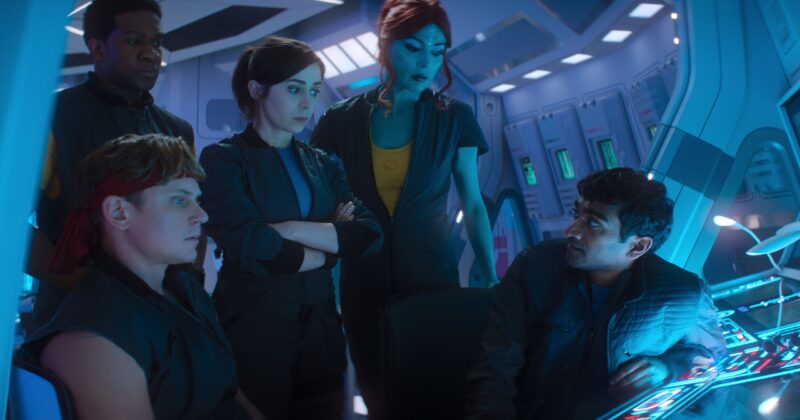
This visual and stylistic elasticity isn’t just for show. Animation liberates creators from the practical constraints of live production, enabling seamless world-building and truly audacious spectacle—from grotesquely beautiful alien horror to cosmic ballet, surreal fantasy, or philosophical allegory. It affords storytellers the range to move from brutal action to intimate character studies or playful absurdity, all without compromising scale or ambition. Interestingly, some episodes even blend in live-action, further blurring boundaries and keeping audiences off-balance.
Constant Innovation, Never-Ending Stories
‘Love, Death & Robots’ thrives precisely because it refuses definition. Its never-settled tone, free-associative storytelling, and fearless production techniques create a playground where sci-fi is less a genre than a passport to possibility. This is why the well never runs dry: the series is unconstrained by a single point of view, a limited mission, or traditional format. Each new batch of episodes is an invitation to expect the wonderfully unexpected, making it the streaming era’s richest source of adventurous, genre-blending short fiction.
As digital audiences demand ever-more innovative, visually daring content, Love, Death & Robots stands as proof that, with the right creative latitude, anthologies can be both unending and ever-refreshing—turning sci-fi into the ultimate narrative sandbox.